

READ THE OPENING CHAPTER of our book

Purpose and growth belong together
The growth pressures leaders face are real and non-negotiable, and many don’t think of Purpose as a solution. However, when Purpose is properly defined and activated across the business, it is one of the most under-leveraged drivers of growth available today.
We’ve spent our careers working side by side with senior leaders in organizations including Mattel, Gap Inc., Sephora, The Coca-Cola Company, adidas, Akamai, and the Project Management Institute. And we’ve interviewed leaders from Google, Starbucks, Apple, Microsoft, H&M, and LEGO, to name just a few. We’ve been there in the moments when Purpose unlocked new growth no other lever could – and also when things didn’t work out as planned. We’ve seen firsthand what happens when Purpose is defined with rigor and lived with conviction, as well as when it just sits in a strategy deck or is activated only as a marketing campaign, often accompanied by a quiet fear of saying or doing the wrong thing and facing backlash. We’ve helped leaders turn Purpose from an abstract idea into a concrete driver of growth, and we’ve seen the difference it makes when it truly takes hold across an organization and its brands. This book is not just a theoretical perspective, it is rooted in real-world experience, and the successes we’ve witnessed are what compelled us to share our story.
We’ve also watched the broader market reduce Purpose to feel-good statements, social impact programs, or exercises in virtue signaling, and we’ve seen the commercial cost of that misunderstanding compound year after year. The gap between what Purpose can do and what most organizations make of it is exactly what this book is designed to close.
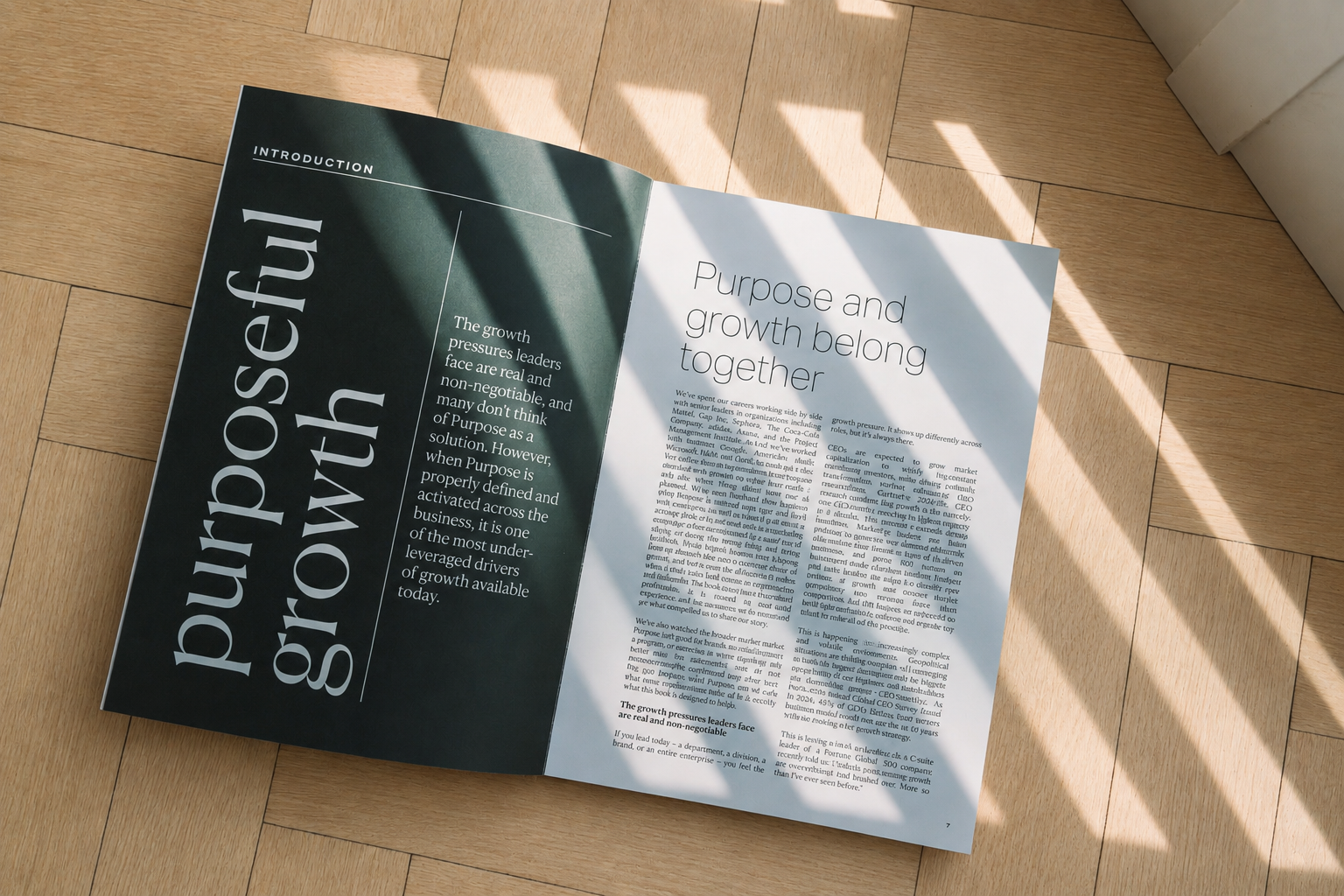
The growth pressures leaders face are real and non-negotiable
If you lead today – a department, a division, a brand, or an entire enterprise – you feel the growth pressure. It shows up differently across roles, but it’s always there.
CEOs are expected to grow market capitalization to satisfy increasingly demanding investors, while driving constant transformation without exhausting their organizations. Gartner’s 2024-25 CEO research confirms that growth is the number- one CEO priority, reaching its highest urgency in a decade. This pressure cascades across functions. Marketing leaders are under pressure to generate new demand efficiently, differentiate their brands in a sea of AI-driven sameness, and prove ROI (return on investment) under relentless scrutiny. Product and sales leaders are asked to identify new sources of growth and convert market opportunity into revenue faster than competitors. And HR leaders are expected to build high-performing cultures and engage top talent to make all of this possible.
This is happening in an increasingly complex and volatile environment: geopolitical situations are shifting overnight, AI is emerging as both the biggest disruption and the biggest opportunity of our lifetimes, and stakeholders are demanding greater accountability. As PwC’s 27th Annual Global CEO Survey found in 2024, 45% of CEOs believe their current business model would not survive in 10 years without evolving their growth strategy.
This is leaving a mark on leaders. As a C-suite leader of a Fortune Global 500 company recently told us: “Leadership teams everywhere are overwhelmed and burned out. More so than I’ve ever seen before.”
So why should any leader care about Purpose?
Given this reality, it’s no surprise there has been pushback against any definition of Purpose that feels non-essential to sustained, profitable business growth.
For too long, Purpose has been confused with philanthropy; sustainability; diversity, equity, and inclusion (DEI); or corporate social responsibility (CSR) – treated as optional and adjacent to the business, not central to it.
A Fortune Global 500 executive told us: “As soon as you bring Purpose into the conversation, it immediately gets shoehorned into its own little CSR box. And while it’s great to help people, good intentions don’t put food on the table. Which means this kind of Purpose becomes irrelevant very quickly.” Another Fortune 500 leader agreed: “Any investment in this space [philanthropy, sustainability, DEI, or CSR] can often be seen as an inhibitor to growth. So Purpose through that lens has a very limited shelf life.”
When Purpose is framed this way, it is entirely rational for leaders to be skeptical. Faced with relentless growth pressure, most of what has been called Purpose feels irrelevant to the problems leaders are trying to solve every day. Before making the case for what we believe Purpose actually is, and why it is one of the most under-leveraged sources of new growth, it’s worth examining where even the most sophisticated “traditional” approaches to growth consistently leave potential unrealized.
Where traditional approaches to growth fall short
Organizations such as McKinsey, Bain, BCG, Deloitte, Accenture, and Korn Ferry have advanced how companies think about strategy, operating models, transformation, culture, leadership capability, and market development with extraordinary rigor, all in service to unlocking more growth. We are not here to critique their frameworks. We have worked alongside many of these companies, and this book does not compete with what they are doing. But throughout our work, we have seen four areas where even the best traditional consulting approaches consistently leave growth potential dormant.
Leadership. Consultancies build smart strategies. What they don’t solve is why those strategies fail to matter to the people who are asked to understand, commit to, and execute them. MIT Sloan Management Review research found that only 28% of executives responsible for execution can name three of their company’s strategic priorities. That last mile is not a strategy problem – it’s a meaning problem.
Culture. Many culture frameworks are focused on organizational alignment, leadership accountability, and transformation. But they don’t give people a reason to care. According to Deloitte, nearly half of Gen Z and Millennials have left roles that they felt lacked Purpose. In fact, according to Gallup, nearly 80% of employees worldwide are not engaged or have actively disengaged. Organizational performance isn’t unlocked by wording exercises around “values.” It’s unlocked by meaning.
Innovation. Innovation frameworks are excellent at telling organizations how to innovate. What they often lack is clarity on where to direct that capability and why it matters. Without a clear sense of the human needs that organizations are uniquely positioned to address, innovation defaults to incrementalism rather than breakthroughs. BCG’s 2025 study of over 1,250 global firms found that 60% of companies are achieving no material value from their AI innovation investments, because they are stuck in “incremental productivity improvements” instead of truly asking themselves how their innovation work will change outcomes for their customers.
Brand. Technology can now build awareness and salience at scale. What it cannot manufacture is genuine meaning - the kind that makes a brand matter in someone’s life, commands preference over functionally equivalent competitors, and earns loyalty that outlasts the next sales promotion. According to Havas’s Meaningful Brands 2025 Global Report, consumers globally say they would not care if 78% of the brands they use disappeared tomorrow. That’s roughly four out of five brands being seen as disposable.
Across all these gaps one central insight becomes painfully clear: traditional approaches solve the what and how with sophistication. What they consistently underleverage is the why. As the CMO of a brand operating in over 70 countries told us: “We’ve articulated and executed some very smart strategies, but some things just haven’t moved. That’s because of the lack of shared identity across the organization. And that is down to Purpose.”
In leadership, culture, innovation, and brand, the absence of a compelling why is precisely what prevents the what and how from reaching their full potential. Without it, leadership remains transactional, culture becomes compliance, innovation defaults to incrementalism, and brands fail to matter. This is not a marginal inefficiency. It is a systemic loss of growth.
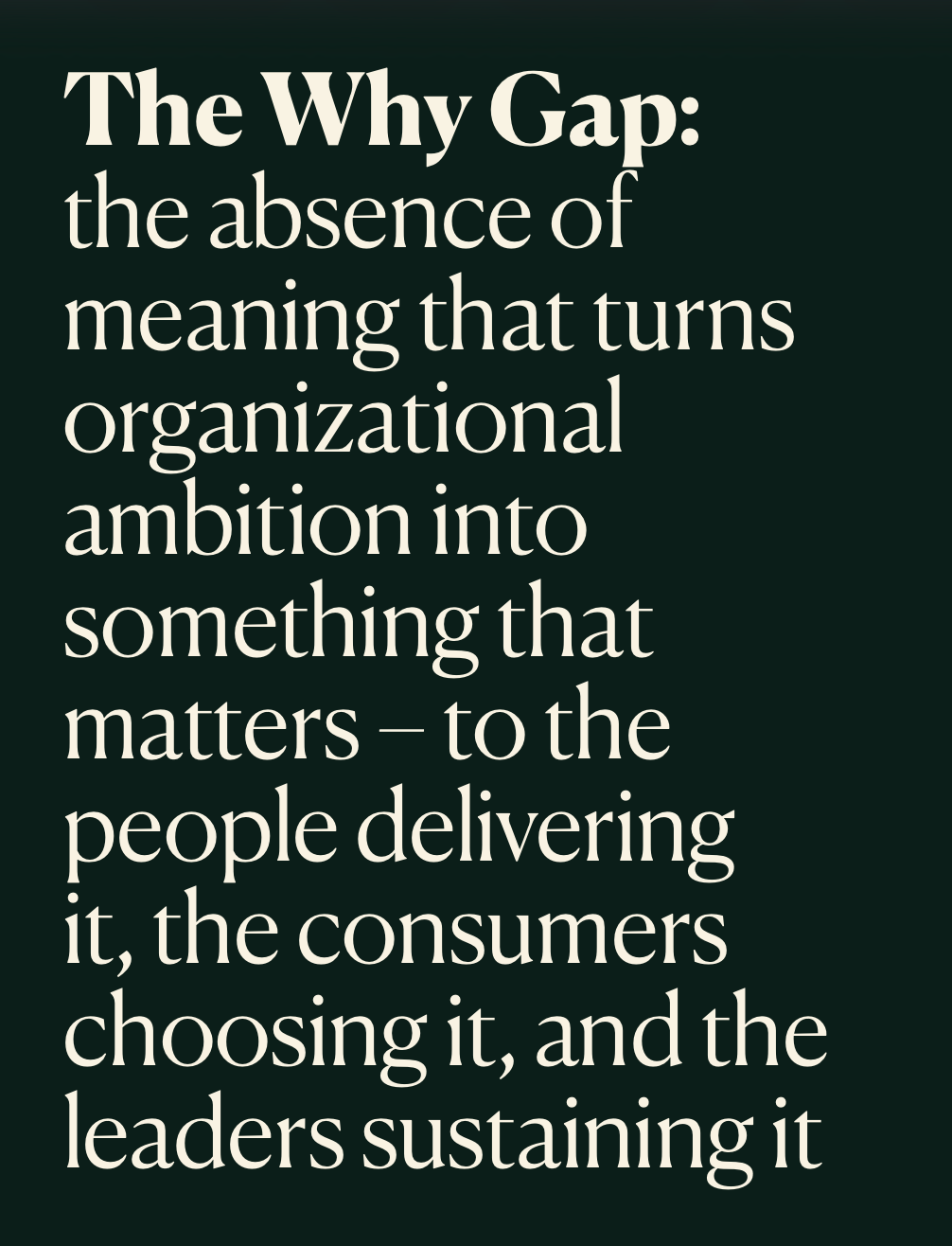
We call this the Why Gap: the absence of meaning that turns organizational ambition into something that matters – to the people delivering it, the consumers choosing it, and the leaders sustaining it.
Purpose isn’t a replacement for existing frameworks. It’s the missing ingredient that unlocks their full potential by closing their Why Gap, thus making them more meaningful for employees, consumers, and all other stakeholders.
How we define true Purpose, and how it can drive growth
Purpose, as we define it, works at a level other levers cannot reach: creating meaning. It is the one dimension that strategy and technology alone cannot manufacture. But not any Purpose will do. Most of what gets called Purpose never comes close to delivering the kind of systemic impact we’ve seen at Mattel, Gap Inc., or Sephora. For Purpose to truly drive growth, it must meet a higher standard:
Central to the business, not a peripheral add-on
Grounded in unique capabilities, not generic claims anyone could make
Relevant to a meaningful human need, not inward-looking or self-referential
These distinctions matter commercially. When Purpose is central to the business, it shapes where you play and how you win, directly influencing strategy, investment, and decision- making across the business. When it is grounded in unique capabilities, it becomes defensible, credible, and actionable – harder for competitors to copy and easier for the organization to act on. And the more important the human need a Purpose addresses, the more meaning it creates, and the more it closes the Why Gap, resulting in more power to drive growth across leadership, culture, innovation, and brand. Trivial Purposes produce trivial outcomes.
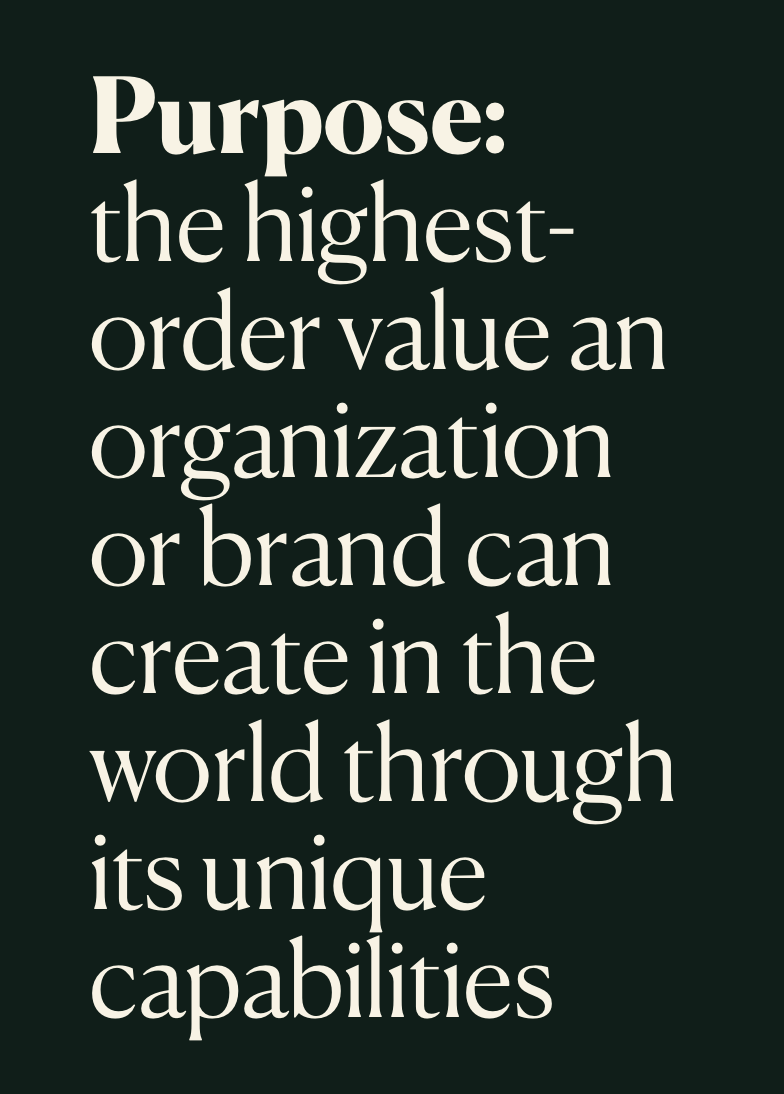
All of this, and decades of our own experience as leaders and consultants, have informed our own definition of Purpose: the highest-order value an organization or brand can create in the world through its unique capabilities, expressing not what it makes or sells, but what it enables for people by addressing a broad human need.
When Purpose meets this standard, and when it’s clearly defined and applied across the business, it unlocks new growth across the four domains we’ve mentioned previously: it makes leadership more meaningful; it creates committed, high-performing cultures; it inspires more ambitious and human-centered innovation; and it builds brands that matter. That’s why we defined these four domains – leadership, culture, innovation, and brand – as the Purposeful Growth Drivers in this book.
At this stage, it’s helpful to briefly distinguish between company Purpose and brand Purpose. Company Purpose is organizational in nature and designed to speak to all stakeholders, whereas brand Purpose is focused more narrowly on consumers and the ecosystem directly surrounding a specific brand (its employees, vendors, and closest partners). Throughout this book, we use Purpose to refer to both, and will unpack the distinction where it becomes most relevant.
“To us, Purpose is closely tied to business opportunity. It’s fully connected into our market growth planning and our store development strategy”
Finally, while we hold clear distinctions between the concepts of Purpose, Mission, and Vision, many of the companies referenced in this book use these terms interchangeably. We therefore decided to take a practical approach: rather than getting caught up in terminology, we focus on the underlying idea that articulates why an organization exists and the value it seeks to add to the world. This overarching intent is what matters most, and it is the spirit in which we use the term Purpose throughout.
Purposeful Growth
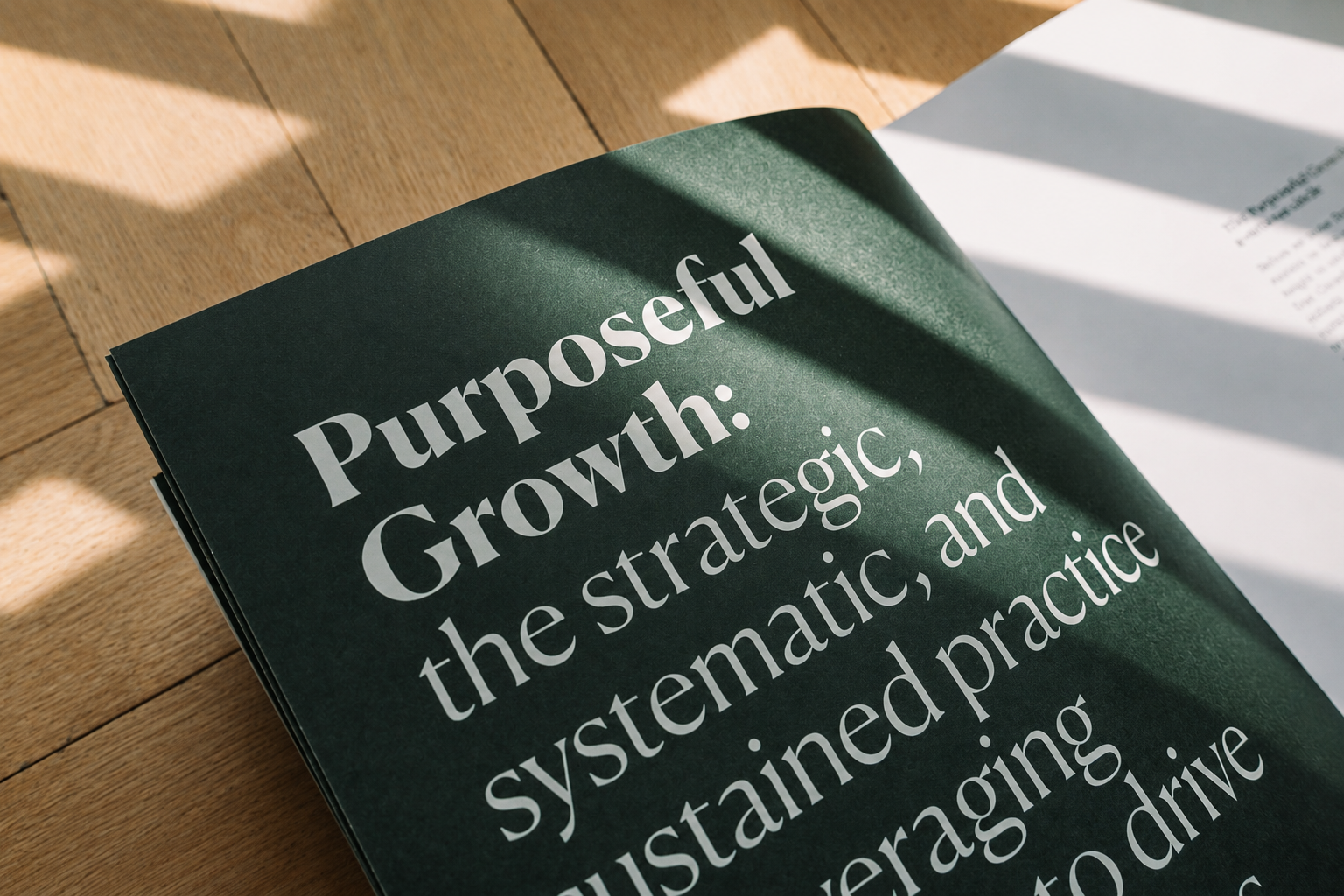
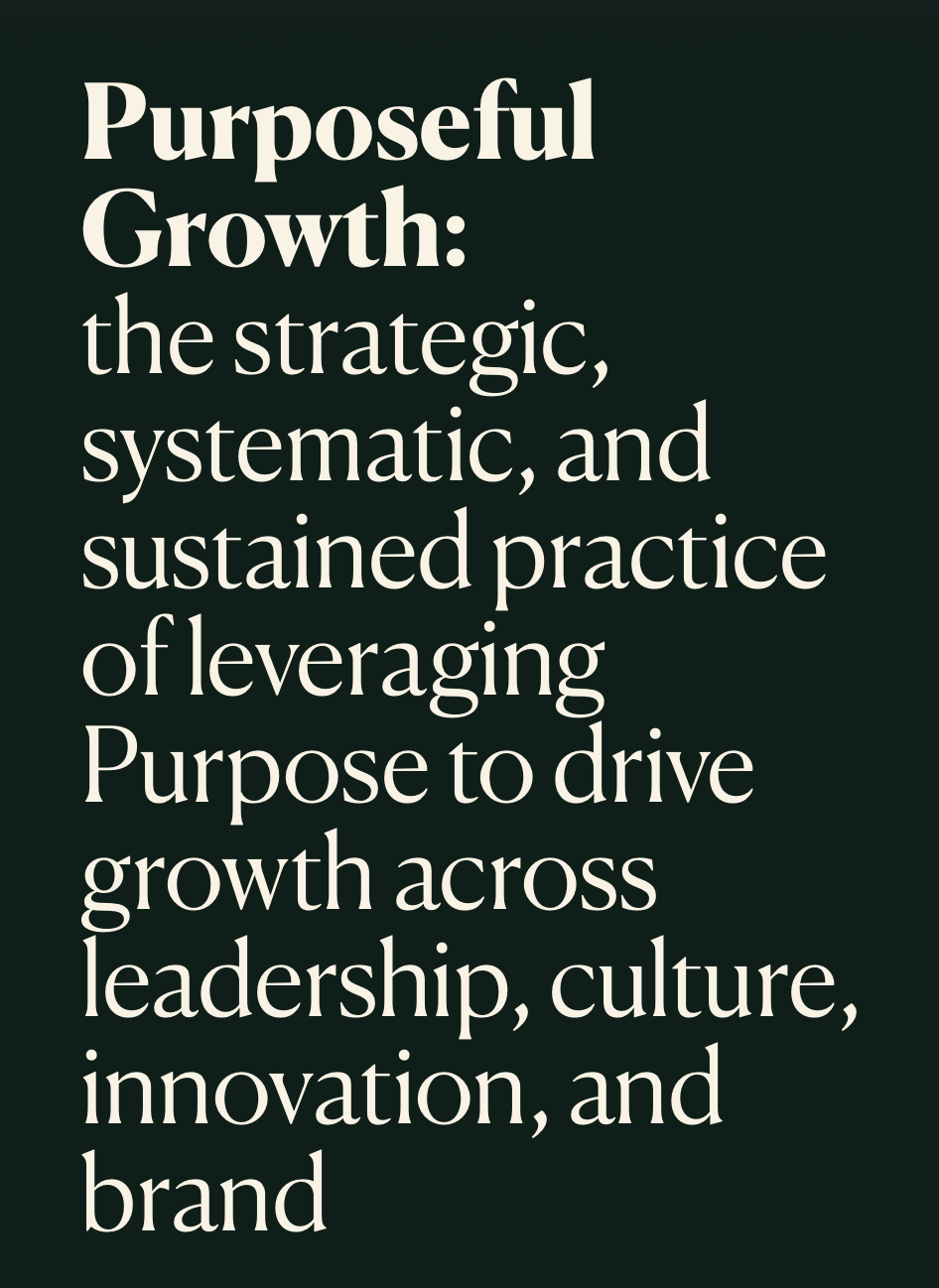
The four Growth Drivers we’ve defined do not operate in isolation. Fueled by a central Purpose, they reinforce and compound each other in service of commercial growth. This is what we call Purposeful Growth: the strategic, systematic, and sustained practice of leveraging Purpose to drive growth across leadership, culture, innovation, and brand.
Why this matters beyond the bottom line
If all of this sounds as though we believe Purpose is one of the most powerful commercial engines available to leaders today, it’s because we do. The gap between what Purpose is often misunderstood to be, and what it can actually do to create growth, is substantial. So if you are looking to leverage Purpose purely to create new and better growth, you’ve come to the right place.
But for many, Purpose is bigger than that, and we’ve often seen it become highly personal for senior leaders we’ve worked with. Purpose creates meaning. It also creates legacy. Discovering and defining Purpose is one of the few decisions a leader makes that can outlast them. Markets shift and strategies change. A clear Purpose creates continuity; something an organization can be guided and inspired by long after any single operating plan or tenure has passed.
As a Fortune Global 500 CMO told us: “We are called upon as leaders to be more than governors of a balance sheet. Being a leader requires a different level of passion and obsession. And I want to be passionate and obsessed with something that can actually make a difference in the world.” This sentiment is reflected by many leaders we spoke to in highly commercially minded organizations.
That is how some leaders choose to move beyond growth and toward creating legacy: not just through what they deliver in the next quarter, but also through what they set in motion for the next decade. They shape a culture that does more than improve performance; one that also helps their people see why their work matters. They inspire the organization to address the problems that are worth solving. And they create brands that do more than outperform competitors, earning a place in culture that transcends product cycles, campaigns, or leadership changes.
And, increasingly, that legacy can extend beyond the company itself. The world is facing challenges that demand new solutions, from the transition to clean energy and more resilient food systems to improving the health and wellbeing of people everywhere. Leaders who look at these challenges as new value creation opportunities don’t just open up new markets, they also help shape the direction of society. They build businesses that grow by solving problems, instead of creating new ones. And they don’t do this by stepping outside of their core capabilities, but by applying what their organizations do best to problems that matter at scale.
Problems of this magnitude can’t be solved in one go, but Purpose allows companies and leaders to start deliberately, where they are, and then intentionally decide how far they want to go.
An executive leading programs across more than 175 markets and regions summed it up: “If we make the world’s best products that truly answer the needs of 8 billion people in communities everywhere, that is the service we’ve done to the world. That is at the core of our Purpose.”
The Purposeful Growth Drivers: a virtuous circle
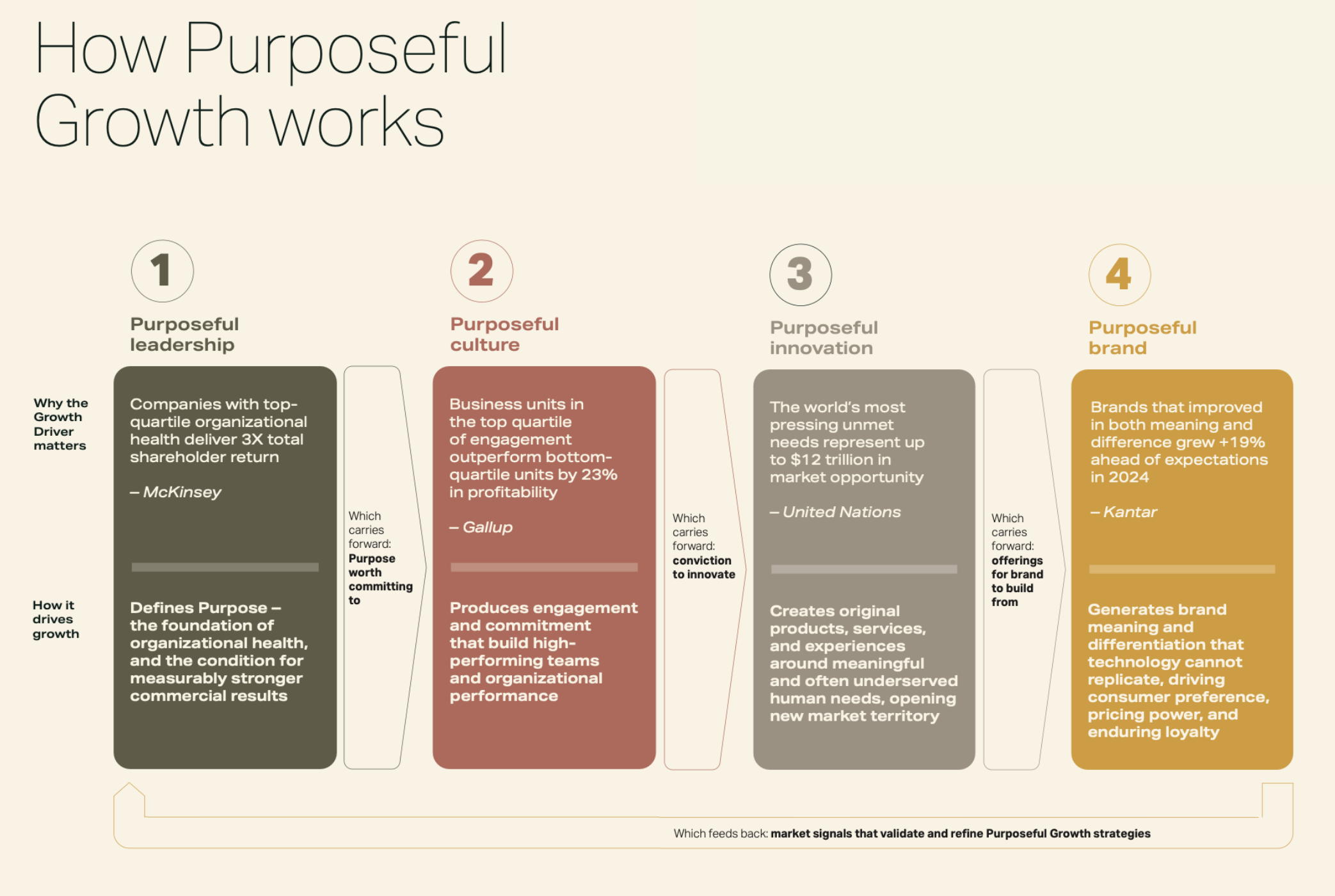
Before we move from why Purposeful Growth matters to how it works, there is one central insight to establish. It is tempting to read the four Growth Drivers as a sequence that only delivers commercial value at the end, culminating in brand. The reality is that each one generates growth in its own right, while also creating the conditions that make the next driver more powerful.
Purposeful leadership creates the clarity, meaning, and focus that drive organizational health, resulting in measurably stronger commercial results – and it gives culture a Purpose worth committing to.
Purposeful culture produces the engagement and commitment that build high-performing teams – and gives innovation the conviction and creative energy to pursue meaningful breakthroughs.
Purposeful innovation creates original products, services, and experiences around underserved human needs, opening new market territory – and it gives brand something real from which to build meaning and differentiation.
Purposeful brands generate the consumer preference, pricing power, and loyalty that technology alone cannot manufacture – and they return the market signals that sharpen leadership’s understanding and refine where Purpose is directed next.
The Purposeful Growth Flywheel
The result is not a linear sequence but a flywheel: each Growth Driver delivers growth in its own right, while improving the conditions for the one that follows, with brand closing the loop back to leadership. The more deliberately the flywheel turns, the more Purposeful Growth compounds. This book is the guide to turning it. Deliberately, systematically, and with the full commercial impact the flywheel is capable of generating.
Our book will be available to purchase soon. In the meantime, if anything sparks your interest in this or the following articles, please do email philipp@purposefulgrowth.co